
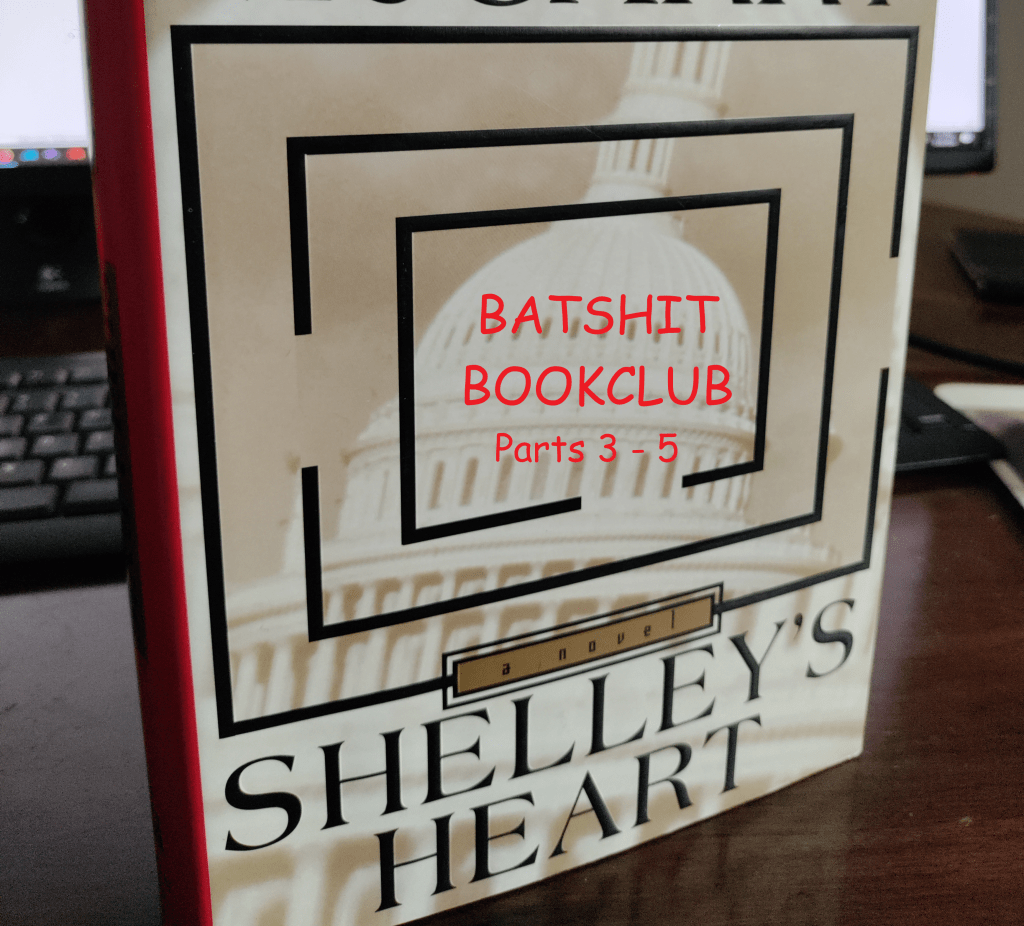
In an interview with Bookworm’s Michael Silverblatt, William H. Gass, in response to a question about the particular density of the first section of The Tunnel, explains that it is a sort of gauge, a test of fortitude where readers prove their worthiness for what comes after: “What it is is to make sure that the person who gets into the book is ready and deserves to be there.”
The real test in Shelley’s Heart, not fair, not sane, comes not in the first part of the book, but in the confusing barrens of Parts 3, 4, & 5 – and no reader will be ready, and no reader deserves to be here, wading through McCarry’s interminable bullshit. If you’ve read it yourself, you know, and if you haven’t, well, take a gander at a field report from someone who has gone into these fields of pain.
We Return Briefly to the Vanishing Stand-in
One nice thing about Shelley’s Hearts Middle Sections is that Franklin Mallory is backgrounded – mostly. Y’see, even though his previous partner, Susan Grant, was murdered in front of him within the last month or so, Mallory has taken a shine to Zarah Christopher, daughter of famous CIA spy Paul Christopher. Paul Christopher is McCarry’s George Smiley, a poet-spy who starred in many of his thrillers before Shelley’s Heart. Having not read those books I don’t know how much Zarah figures into them, but here in Shelley’s Heart she immediately beguiles Mallory:
With Zarah, however, [Mallory] was now experiencing, on the verge of old age, something he had always been sure did not exist: love at first sight…this woman’s physical being acted in some inexplicable way upon the involuntary functions of his own body. Mallory being Mallory, he had attempted to analyze this phenomenon.
–And McCarry being McCarry, we have to read this analysis, but, again, there’s not as much as I feared there’d be. It’s not all good news, though, because McCarry giveth and he taketh away, and what he giveth here is another tedious self-serious bore of a character, in Zarah Christopher.
Everything I said about Mallory last time can be applied to Zarah, too. She has the same absurd self-righteousness, the same smug debate club personality, the same authorial grace marking her out as Chosen, above the rest of the cast. How annoying is she? Jumping back to part 2 for a minute, here’s an early scene with Zarah, to give you an idea of How She Is:
“I had British teachers as a child.” Zarah addressed herself to Polly [Lockwood, the First Lady]. “It’s a boy’s name, really. It means ‘sunrise’ in Hebrew.”
“Hebrew,” Hammett said, startled. Zarah was blond and gray-eyed, with a face out of a Dürer drawing. “Are you Jewish?”
“No, are you?”
Hammett, defender of Jewry’s most implacable foes, uttered a strangled guffaw. “Good God, no, but it’s a novelty to be asked. In fact, it’s a novelty to meet someone who doesn’t read the papers. Does that come from growing up in the Sahara desert?” Staring at her with intense concentration, he waited for her answer, which did not come. Zarah simply absorbed his question into some pool of silence at the center of her personality.
Lockwood’s eyes flicked in open amusement from Hammett to Zarah. He said, “No offense to old Ross here, but if you can get away from the newspapers in the Sahara Desert, that’s where I want to be. Can you actually do that, Zarah?”
With all the easy charm she had been withholding from Hammett she said, “You sure can if you go to the right place, Mr. President. I never saw one, even in Arabic, until I was grown up.”
Hammett said, “What did you do for news?”
“There wasn’t any.”
“Then what was there?”
She paused for a beat. “Life,” she said without expression.
The sensation, the vibe Zarah exudes is like if all the homeschool kids you ever knew fused together in some horrible singularity. It makes perfect sense in a world presided over by the mad god McCarry that Mallory would find a partner so perfectly attuned to his fucked wavelength. I’m happy for him. It would be wonderful if these two got married and lived happily ever after in some other book I didn’t have to read.
Not going to talk about her much more today but I needed to get a foothold in the Zarah issue because it really comes home to roost in part 6.
A Lament for Structure
There’s an arrhythmia in Shelley’s Heart. In parts 1 & 2, you get the feeling the book is going exactly where it says it’s going: that it will deliver a political thriller about a contested election, rife with the snakepit politicking that is the main draw of the sub-genre. Sure, it’s impossible not to notice that McCarry is an author with more complicated ambitions than ‘merely’ writing a good thriller, & that he’s aiming his book at a higher target than pure entertainment; but you still feel comfortable believing, early on at least, that this ambition will not get in the way of what promises to be a fast-moving plot, & that once things reach a certain velocity the ambition, the Points the book tries to make, will get lost inside all that speed, the way that, when you’re driving fast, everything in your peripheral, whether tree or sign or roadside oddity, distills down to the same lightly stippled visual noise that can be discarded with the aetheric intrasecond flicker of a sub-thought.
But in Parts 3 – 5, the “Middle Section,” a slew of new characters enter from previously unseen trapdoors in what you assumed was a sturdy, sound plot, built on solid foundations; characters each with own dubious claims on authorial attention in the form of subplots, sidestories, vignettes – most of which do seem to be on trajectories aimed at the central plot, it’s true, but in their waywardness they hinder that central plot’s momentum, adding developments that could have been introduced in a much straightforwarder way with existing characters & closer-to-the-core situations.
In Go/Baduk, you are always looking to play efficiently; accomplishing multiple things with fewer stones is always better. In Shelley’s Heart, McCarry spends so many pages and so much time looping these side-episodes back into the main story so that they can effect some single, specific change within it; and because the book has to manage multiple simultaneous threads, there can be a major lapse of time and pages before the way in which any side thing connects to the main thing becomes clear;the horrid dinner scene (discussed below) is the prime example of this.
“More is more” says Stanley Elkin, but Elkin is an artist, and McCarry, despite ambition, is a potboiler, a pop novelist. There’s often much to admire, much art, in popular fiction, but here in Shelley’s Heart little if any of the artistic thrusts stick.McCarry’s not enough of a stylist to make the individual sentences satisfying in and of themselves; if you’re here, you’re here for what they lead to, not their own music; but because there are so many sentences, and so many of them to greater & lesser degrees not necessary, it’s hard, on the long, long road of Shelley’s Heart, to keep up interest in that destination.
Epic-length thrillers aren’t uncommon, but they demand orchestration on the writer’s part, and Shelley’s Heart overlarded interior comes across less like an orchestra and more like a bunch of weird guys jamming within earshot of each other. It’s impossible to stop thinking that the book would’ve worked better, been clearer, with less cruft – especially when the cruft sucks so much shit that it saps actual life essence from you.
Some of These Scenes are So Fucked, Man
The pacing problems, the unnecessary scenes, & McCarry’s general reactionary bullshit all reach an apotheosis in a dinner party scene near the end of part 4. It is, without doubt, one of the worst scenes I’ve read in a book, ever, and if I weren’t reading this with the specific intent of exploring complexly bad books, I would have stopped here (if I managed to make it this far).
At this dinner party, Archimedes Hammett, the scheming, freshly-minted Chief Justice of the United States, has brought along one of his lackies, Slim Eve, with the explicit intention of using her to seduce R. Tucker Attenborough, Speaker of the House, for reasons that are too complicated to get into here – “you’ll just have to read the damn thing!” Anyway, Slim is gay, and an ecolawyer who also runs an organic farm with her partner Sturdi – all of this, quite obviously, is very funny to McCarry: his sense of humor can be dry and witty, but whenever it involves elements of the modern world he clearly doesn’t like (y’know, stuff like Feminism and homosexuality, vegetarians and revolutionaries) the humor becomes sniggering and pencil-necky; I’ve never wanted to kick sand in an author’s face before but McCarry’s authorial voice is really the printed word equivalent of a backpfeifengesicht…
When it comes to Slim and Sturdi, they are not permitted one sentence’s worth of dignity, or, really, even humanity: they are cartoons. Look (to revisit a scene from last time), McCarry even sets them up in the classic frat bro trope of the ‘One Hot One, One Ugly One’ lesbian couple (ellipses mine, here and throughout):
Hammett made a gesture to someone inside a Volvo station wagon that was parked at the curb with its motor idling. Two women dressed in ankle-length calico dresses and hiking boots got out of the car…One was blond, thin and willowy, with enormous blue eyes, like a Vogue model…her thin skirt blew around her long and unusually beautiful legs. Despite the weather, they were bare.
Macalaster said, “The skinny one is going to catch pneumonia.”
“Not her,” Hammett said. “She’s absolutely impervious to cold.” The other one…was rawboned and as tall and broad-shouldered as a good-sized man…she caught Macalaster staring at her friend’s legs and sneered in feminist disgust.
Slim is the Hot One, so she’s the honey pot for Attenborough. Attenborough, who could be glimpsed here and there earlier in the book, rockets into the limelight in this middle section and, by the end of part 5, it’s clear that he’ll be a major character going forward – that odd plot rhythm again. Slim sits next to Attenborough at the dinner table and he begins to grope her:
Attenborough gave her a pat on the arm, as if she had been the one whupped with a one-inch trace. Then, deftly, he laid a child-size hand on her thigh under the table. She reached down and captured it in her own larger hand, which was surprisingly rough as a result of her work on the farm…
“Were you gentle with your own children, Mr. Speaker?”
“Tucker, call me Tucker,” Attenborough said, stroking the backs of her ringless fingers with his thumb. “Never had any, never was married.” He gave Slim’s hand a meaningful squeeze.
This is all about to get a lot worse, but even in the midst of this McCarry can’t resist a little snickering dig at the funny organic farmer lady:
In his other hand the servant held a silver bowl filled with some kind of vegetable casserole. Attenborough sniffed this dish, then waved it away.
“No veggies?” Slim said. “I made that ratatouille myself, out of organically grown ingredients. It’s the Chief Justice’s favorite. No salt or chemicals of any kind.”
“Ratatootie?” Attenborough had slipped deeper into a parody of good-old-boy speech and behavior as the level of the vodka in his water tumbler dropped inch by inch. “Is that some kind of Arab dish?” he asked, pronouncing the word AY-rab.
Attenborough’s alcoholism becomes a major character and plot element at this time, although it (and he) were given no particular narrative weight before. Well, Attenborough continues to grope Slim:
His fingers walked upward, as in a child’s game of mousie-mousie. She was unable to defend herself and lift food from the platter at the same time. With amazing swiftness and dexterity Attenborough’s hand lifted up her short skirt, folded it back over her napkin, and scurried up the inside of her thigh. Startled, yet not surprised, she twitched slightly, relaxing her legs; through a rip in the crotch of her panty hose, two scurrying fingers found her labia. A third searched for her clitoris; she was back in high school, the pre-enlightened Slim.
I don’t want to say McCarry has never had sex, but he writes like someone who was probably not the greatest lover – I dunno, something about the clinical-anatomical terms, maybe – and also the way he usually calls women ‘females’ throughout the book…..anyway, this scene gets worse, and because I read it, anybody stuck here with me has to read it, too:
To her surprise, Slim realized that she was approaching orgasm. It wasn’t Attenborough who was producing this pleasure, it was the situation, it was the memory of other men. But she could not let it go on. Feigning interest in what was being said across the table and continuing to eat with her left hand, she reached down and grasped Attenborough’s hand with her free right hand and dug her thumbnail into the tender wrist joint.
You also need to know that, in the middle of this struggle, McCarry takes a break to move us around the table so we can overhear a conversation about Shelley between Hammett and Zarah Christopher. If I didn’t mention last time, the election fraud at the heart of Shelley’s Heart’s plot was instigated by members of a secret society called the Shelley Society, who idolize the poet and try to enact their “radical agenda” in his name. It’s complicated, and arguably the stupidest element of a plot not lacking in stupid elements, but the point here is that, in the fucksy-turvy moral universe of Shelley’s Heart, anyone who likes Shelly the poet is obviously an idiot, viz:
“What do you know about Shelley?” Hammett was asking.
“Very little,” Zarah said. “Except that he was a totalitarian.”
“Hammett’s sulky face darkened. “Explain that,” he said.
“Alright,” Zarah said. “Prometheus Unbound reads like a dream Stalin had in an opium den. Shelley describes heaven on earth as a place where people fall asleep and when they wake up they’re not human any longer. They’ve taken off their human nature and condition like a disguise; therefore they’re happy because now they’re all alike, thinking beautiful thoughts. Utopia always turns out to be an eternal prison camp with people like Shelley in the commandant’s office.”
Keep in mind, this bullshit happens in the middle of the Attenborough/Slim business. Attenborough then quotes lines from “To a Sky-Lark” as he continues to molest Slim, until she can’t take it anymore:
Slim shrieked, “Help!”
Underneath the table, Attenborough’s middle finger had broken through. His victim leapt to her feet, overturning her chair. Beneath her skirt, she was still holding his wrist in both hands. It was an extremely short skirt. Slim had truly wonderful legs, and there was no mistaking what had been happening.
This isn’t even the end of the scene, but it’s I’m ending things here. Y’know, one sad thing is that, at the end of Part 5, things seem to start focusing again: there’s a scene between Lockwood and Mallory, a sort of showdown in the Oval Office where this massive political struggle is distilled down, in a tense moment, into a battle of wills, something very personal and petty and heated. After the glut & gauntlet of most of the rest of the Middle Section, this scene feels like it comes from a different book altogether – the book that, early on, you probably thought you were getting, before the hidden doors opened and you started getting invited to the dinner parties.
What a mess.
Next time: Parts 6 & 7. Will things get better? Probably not!
 Demilecteur