Batshit Book Club: Shelley’s Heart by Charles McCarry (Final)

Last week I discussed the point at which I lost all hope for a redeeming resolution in Shelley’s Heart. The book had been so bad, in such a narrow way, for so long, that it exploded my explorer’s optimism; but in that explosion a piece of shrapnel must’ve gotten lodged in some extremity because, somehow, even as I neared the long-awaited End, I began to think I believed that the plot would, despite everything, at least close out in a memorably bad way.

Well.

At the End of the Tunnel, a Wall

After 500+ pages of political thriller watered down with low-effort spy fiction, of absurd digressions, irrelevant sci-fi bombshells, reactionary political fantasia, of Slim and Sturdi Eve, Franklin Mallory, Zarah Christopher, and the rest of the cavalcade, McCarry closes out his faecum opus with a downward arpeggio of anticlimaxes, off-stage resolutions, and sanctimonious narratorial hand-waves.

There are artistic, deliberate ways in which books can be left unfinished. But you have to earn it, and Shelley’s Heart doesn’t earn it. A book as needlessly prolix asthis, that seemingly cannot help itself from dashing off on absurd digressions, or from underlining for the dozenth time its author’s specific crochets & hangups, cannot now be terse when the time comes to pay what even the most basic, plainest stories owe. I’ve seen fucking cave paintings with better story structure than this.

Of two of the main architects of the stolen election that kicks off the entire book, McCarry says:

It was not yet known what would happen to Julian and Rose MacKenzie.

That’s it! These are characters who have had whole chapters, whole sequences devoted to them, by the way, and they get dropped like toys. Others important characters don’t even get mentioned at the end: how about Alfonso Olmedo C., J.L.S. McGraw, Emily Hubbard, Carlisle Blackstone?

The reason, of course, is that McCarry didn’t know how to bring his diarrheal avalanche to a stop – not without expending another 100 pages at least. This is the inevitable, gnarly, particolored pileup that happens when you send so many clown cars in the same direction. And far be it from me to wish that Shelley’s Heart were a page longer than it is, but the simple fact is that, even if the novel’s general verbal indulgence is one of its chiefest flaws, this final trailing-off seems like a dereliction of authorial duty. This is not artistically acceptable vagueness. This is “I threw so much shit at the wall and none of its sticking oh God how can I sneak out of the house before anybody sees the mess I’ve made?”

Showdown at the Not OK Corral; or, Lucy & the Boy-Girl Machine Pistol

The courtroom-constitutional drama ends abruptly. The seemingly central question of the presidential succession following a stolen election are resolved lamely, tamely. These tepid sequences are the last fossils of the political drama this book, at one time, seemed like it would be about, but at some point McCarry decided he was more interested in the espionage and spy stuff, which has been encroaching on the core of the book for at least 100 pages, and whose mascot is Zarah, who you know is McCarry’s favorite because she gets to waste the two evil lesbian terrorists in a super cool shootout at the end that, in comparison to the final bits of political wrangling, is positively lavish in its production value.

Zarah, along with Franklin Mallory’s favorite boy-girl security people, Lucy and Wiggins (Wiggins!), end up discovering that Slim and Sturdi Eve (if you forgot: lesbian ecolawyer terrorists) were behind the assassination, early in the book, of Mallory’s last romantic partner, Susan Grant. Up until now everyone assumed the assassination was the work of a terrorist organization called The Eye of Gaza, and that Susan was unfortunate collateral damage in an attempt on Mallory’s life. But no, as it turns out, Slim and Sturdi, being radical liberals, purposely killed Grant because they discovered she was pregnant with Mallory’s child, and the thought of his political line being carried forward into a new generation was unbearable.

Once they put all this together, Zarah decides that she will pretend she’s pregnant with Mallory’s child, so that the deadly duo come after her. Which they immediately do, because when it comes to criminal acumen Slim and Sturdi are basically on the level of, like, Team Rocket. In her genuine Terrorist Caftan, Slim approaches Zarah, but Lucy intercepts her; she had been waiting in a nearby lake, underwater, like a ninja in an old anime [ellipses mine]:

Half an hour earlier, Lucy had swum across the lake underwater, her snorkel tube creating the beautiful ripple Zarah had seen from the clearing…Now Lucy saw the brilliant flash through the lake’s surface and rose to her knees out of the shallows in which she had been lying…Training had eliminated the need for thought – even, as Zarah had foreseen, for intuition. Holding her 6mm all-vinyl♂↔♀-issue machine pistol in both hands at the end of rigidly outthrust arms, Lucy fired a burst of 12 mercury-weighted, vinyl-tipped, soft copper rounds into the heart and lungs of the person who had killed Susan Grant.

Contra my own directives with Batshit Book Club, I’ve summarized the plot here, but I needed to in order to highlight that this book’s most notable, longest climactic scene involves the Tom Clancian tactical takedown of an ecolawyer-couple-turned-liberal-domestic-terrorist-cell. It’s all taken out very seriously, with a po-faced, unearned nobility, but McCarry, does allow himself to point out, one last time, that Slim is the hot lesbian in the couple, even in death:

With her pistol pointed at the corpse’s head, Lucy folded back the hood of the caftan. A shining cascade of hair spilled onto the damp soil. The face was quite beautiful in its wide-eyed astonishment, and to Zarah she looked very much as she had when she was enticing Attenborough, like an actress summoning up a former self to make the character she was playing believable.

Awkward Envoi

The final scene between those two icons of tedium, Franklin Mallory and Zarah Christopher, is laughable, both for bathos and brevity. It may be the shortest chapter in the whole book, occupying less than a page. Here’s the meat of it [ellipsis here belongs to McCarry]:

Zarah said, “I want to say this to you, Franklin. I wish your child had been saved.”

“So do I,” Mallory said. “How I wish you’d stay. It’s very hard to accept that there’s no chance of having the child I’ve waited for all my life.”

“I thought you knew that already,” Zarah said.

“Not in quite the impossible way I do at this moment. I’ve never thanked you. What you did, seeing the truth, seeing the obvious, walking into the woods that way and…willing your death not to happen.” He paused. “I just wish you didn’t want so badly to be”- he searched for word – “apart.”

“It runs in the family,” said Zarah. “Goodbye.”

Just the word, not the smallest gesture. She simply left. Watching her walk down the hill, so singular and uncaptured, he fell into a reverie, wishing for a child in which they could both go on living.

There are many things McCarry does wrong in Shelley’s Heart, but you gotta admit, perhaps never before in literature (certainly not since Ayn Rand) has an author so indelibly captured the nuance, poetry, and nobility of Libertarian Romance…

The best novel ever written about life in high-stakes Washington”

I’m sitting here reading Jonathan Yardley’s 1995 review of Shelley’s Heart and relearning a lesson I somehow often let myself forget, which is that corporate journalists should never be trusted, on any topic. Check out the opener to Yardley’s review:

Not to mince words: Shelley’s Heart is an amazing book. The eighth novel by a writer who to date has been filed away in the pigeonhole of political suspense and/or spy fiction, Shelley’s Heart at once stays within the conventions of genre and soars above them. It is a work of immense ambition that comes astonishingly close to achieving everything toward which it aspires. In so doing it rudely elbows its way into the precinct of “serious” fiction, rendering by comparison almost everything that now passes as such pallid, lifeless and jejune.

And later:

McCarry’s publisher does him no service when it claims that “the intricate, intelligent plot and writing invite comparison with Allen Drury’s Advise and Consent and Fletcher Knebel and Charles Bailey’s 7 Days in May.” Perhaps that comparison will lure readers whose tastes do not venture beyond the best-seller lists, but Shelley’s Heart is to those two novels as “King Lear” is to “The Sound of Music” and “Barefoot in the Park.” The Drury and the Knebel-Bailey are hack entertainments; McCarry, even though he dares not venture beyond genre, has written a work of literature. Its plot is, as advertised, complex and smart.

As a reminder, Yardley is talking here about a book whose main villains include a pair of fanatical liberal ecolawyers thatassassinate pregnant women so they can’t give birth to conservative children. A book in which the environmental movement somehow resulted in feral animals running wild all over the country. In which, somehow, there are not just one, but multiple “radicals” in Congress.

Personally, if I were Frederick Exley, I would want someone else to have written my biography.

Paul Christopher, Play Us Out

Shameful admission: when I closed Shelley’s Heart, I felt an acute desire to find and read The Tears of Autumn. Tears is McCarry’s much earlier, most famous book, the second book to feature his series character Paul Christopher, father of the illimitable Zarah Christopher.

As a reader, as a person, really, I’m highly susceptible to enthusiasm. A habit I wish I’d never developed, one so deeply ingrained at this point that it’s less habit and more an element of character, is this endless hunger for reading blurbs, write-ups, reviews, recommendations, due to some unkillable and childlike belief that they mean anything.

It was Otto Penzler’s and Jonathan Yardley’s praise for McCarry that led me here in the first place – specifically Penzler’s, mystery/thriller maven that he is. And despite slogging through this 500-page scourge, and despite what I literally just said about not trusting journalists, I don’t know if I can rest without giving McCarry’s supposed masterpiece a try. Maybe Shelley’s Heart is the freak in an otherwise solid oeuvre…

So I did find a copy, and I have dipped into it. Not enough to render a verdict, but the forecast, based on these early pages, is a grim one. First paragraph and McCarry’s, um, eccentric approach to gender relations is on full display:

Paul Christopher had been loved by two women who could not understand why he stopped writing poetry. Cathy, his wife, imagined that some earlier girl had poisoned his gift. She became hysterical in bed, believing that she could draw the secret out of his body and into her own, as poison is sucked from a snakebite. Christopher did not try to tell her the truth; she had no right to know it and could not have understood it. Cathy wanted nothing except a poem about herself. She wanted to watch their lovemaking in a sonnet. Christopher could not write it. She punished him with lovers and went back to America.

And, a bit later on, we get an actual couplet from the days when Christopher wrote poetry. I think he made the right choice giving it up:

Desire is not a thing that stops with death,

but joins the corpse and fetus breath to breath…
Batshit Book Club: Shelley’s Heart by Charles McCarry (Parts 6 & 7)

Today in Charlotte it’s hot out, but cloudy, in this way you see all the time in northeast Ohio, but later in the year, in high summer: the sky filled with clouds, lit from behind by the sun, diffusing that light into an even brightness that makes their edges vanish, so the seams between cloud & cloud can’t be seen, and from edge to edge it’s just a featureless silverwhite sheet, stretched like a canvas over its frame, taut, tremulous, lambent; a faceless, close sky that could threaten rain, or suffocating heat, could be a precursor to some greater storm or lead to nothing at all – the clouds could even break up, like bread in water, and drift, mellow & soft over soft breezes, unspooled into high drifts of cirrus among daubs of blue sky.

I’d rather write about the weather than Shelley’s Heart. I’d rather write about the things I see on my walks or 17th century penal law or the Stalked by My Doctor filmic quintet. I’d rather go walking in a deep humid woods through a haze of alien pollens, & come back with a sore throat, watering eyes, and a regal mantilla’s worth of spider web clinging to my clothes, and sunburn. I really, really don’t want to write about Shelley’s Heart.

Oh Dear

Batshit Book Club has bit me in the ass. Our first sally into the world of bad books and immediately my soul is drained. I envisioned BSBC as an outlet for my fascination with interestingly bad commercial fiction, books that, while a failure by the standard metrics, manage through the unique texture of their badness to offer special things to the reader, singular things, worthwhile things that, while not the rarified artistic treasures of High Literature, still have much intrinsic aesthetic value. Hell, whole subcultures exist to explore this concept in other art forms: MST3K & bad movies, or Japanese kusoge culture, which has been a part of games appreciation since its very early days.

There’s a bewitching vibrancy to bad art, and that vibrancy comes from a place very much connected to the sources from which great art draws its power. Bad Art is still art because, like great Great Art, it reaches for the extremes; deliberately or no, it’s exploring hinterlands, fringes, those regions on the edge where the particular falls off (or rises up) into the universal. Any honest creative endeavor is a wild shot, and the arc & ambition of any shots is bracing even if it ultimately lands in the swamp.

But Bad Art and being bad are two separate things, and it’s the gap between those two concepts in which I find myself stuck with Shelley’s Heart. Shelley’s Heart is not bad art, it’s just bad. On a strictly technical, Strunk & White level, it is actually better-written than much Bad Art, but these mostly-adequate, acceptable sentences articulate only the stupidest shit, with the straightest of faces and an infuriating belief in its own importance. If McCarry was a flamboyantly bad writer this would be a better book.

My advice to anyone curious about starting Shelley’s Heart would be: don’t start it. If you absolutely must, just read the first 100 pages and you’ll have experienced the meager best the book can offer, and had a laugh at its obsessions and tastlessnesses before those things recur to the point that they threaten to drive you insane.

Gourmet Club Stupid Books Course

Last week when Batshit Book Club convened, ostensibly to discuss parts 6 & 7 (the same sections that are nominally the topic of this post), the discussion turned quickly into an all-purpose wild hunt therapy session. Basically, we hung the book on a hook and beat the shit out of it, slinging vitriol at any questionable element that came to mind – and Shelley’s Heart is basically all questionable elements.

“I’m ready to call it now,” I said then. “Y’know I was hoping against hope that there’d be something to justify the bullshit in this thing. But like there’s no way this is going to get better. We’ve got, what? less than 150 pages to go? There’s NO way in hell that ANYTHING in those 150 pages could justify the trouble it took to get to them.”

I said too that I dreaded having to write about the many things in Sections 6 & 7 that are tasteless, stupid, or both – the crown jewel of such things being Zarah Christopher’s insane condemnation of Slim Eve’s, the ecolawyer’s, molestation at the hands of alcoholic Speaker of the House R. Tucker Attenborough, in a scene discussed last time around, the worst dinner scene in all of literature. Early on in Part 6, Sturdi, Slim’s partner, brings it up to Zarah in preparation for a law suit against Attenborough and Zarah, in her role as McCarry mouthpiece no. 2, says some reprehensible shit:

“As a woman, you must have seen how distressed she was,” Sturdi said, moving closer.

Zarah stepped back. “No, that’s not what I saw,” she said. “Your client provoked and flirted with Attenborough from the first moment of the evening. She was wearing a very short dress for a lawyer escorted by the Chief Justice of the United States. She was in a state of almost feverish excitement; at first I thought she might be on drugs. And when suddenly, very suddenly, she leaped to her feet and lifted her skirt to display the damage to her clothing – damage that could not possibly have been done in one single grope by the sharpest fingernail in the world – she was obviously in a state of sexual arousal.”

“ ‘A state of sexual arousal’?” Sturdi could scarcely bring herself to repeat the words. “How could such a thing be obvious?”

Zarah was calm, watchful. She replied, “Sense of smell, Ms. Eve.”

There isn’t any real need to underline how revolting this is, but let’s talk about how fucking weird it is. Deep in the thickets of an overlong book I believed, at some point, would be some kind of thriller about high-level politics, I have to listen to characters say shit like to this each other – and they’re all always saying shit like this to each other, and the narrator says shit like this to you all the time. It’s not always this gross, but it is always this stupid. The characters are all morbid dorks and the author seems to take every absurd thing they say or do with utmost literary seriousness.

As an explorer of worthy trash, it behooves you to expect weird/bad elements; but you do so with the understanding that they will not impede, will actually in some ways enhance, the pleasures of the text as a whole. But the opposite is the case here. A fundamentally good political thriller with tasteless characters could be fun in a schlocky way, but Shelley’s Heart is not a fundamentally good political thriller. I’d argue that, at heart, it’s not even about politics, really; at heart, it’s an espionage drama, a story about spies and conspiracies. Obviously McCarry believes the two can work in tandem, and that makes sense on paper, but in this paper, the paper on which Shelley’s Heart is printed, it does not. Each half operates independent of the other – and while I say ‘half,’ it’s really like a 75-25 split, favoring the spy stuff.

So in short you’ve got this failed chimera, this unliving hybrid, and then on top of all that you’ve got the constant bullshit, stuff like this:

Sturdi smiled. The great nose, the furry unplucked eyebrows that suggested equally furry armpits, the faint shadow on the depilated upper lip, contrasted strangely with the bright Teutonic hair of her wig.

Or how about this:

“How am I doing?” Macalaster asked.

“We’ll begin to see more progress soon.” The trainer, nearly all muscle himself, smiled encouragingly. “Anybody can do it,” he said.

“Except the women,” Macalaster said. “They don’t seem to get muscles. Any reason for that? Do they lift in a different way, or what?”

“Women don’t get muscles unless they take steroids,” the trainer said.

“And if they do take steroids?”

“Then they get biceps, just like us.” He lowered his voice, imparting secrets. “They also get bitchy. Even men get aggressive when they take steroids, so women usually stay from them. Besides their hair can fall out.”

The above excerpt is even more insanity-inducing when you realize, later on in the book, that it is Extremely Plot Relevant. Or this:

She had the air of a woman who had known exactly what to expect before she met him and had not been disappointed in the least by the reality. It was a look he recognized. He recognized the touch of her hand, too: back in the fifties Vassar girls, his wife among them, had cultivated the hand-on-your-hand-holding-the-cigarette-lighter trick, linked with the lifting of meaning-filled eyes, especially during senior spring, and nearly every member of his class had succumbed to this particular old one-two before finding out, to their lifelong cost, exactly what the consequences were.

There’s that classic cool McCarry tone! He really sees through the surface of things, and – uh oh, look out, ladies! – this time he has turned his gimlet eye to Vassar!!

I’ve been on an internet blackout for Shelley’s Heart since beginning it, but I’m dying to know what other people who’ve read this thing think.Like are there any academics out there doing their PhDs on McCarry’s fiction? Anyone composing a monograph about the neglected master McCarry? Is there some possibility that his other books are better?

Next time it’ll be the last time, we’re going through the end of this thing. Can redemption be found in a pile of shit?

Hm. Well, later, having embarked on the last bit of Shelley’s Heart, one Batshit Book Club member messaged me:

“Ben. I will hopefully never turn down the pleasure of reading, but you owe me a pint at this point.”

Batshit Book Club: Shelley’s Heart by Charles McCarry (Parts 1 & 2)

Note on Current BSBC Methodology:

There are two intended audiences for Batshit Book Club: the first and primary audience is someone interested in learning about uniquely bad books in an impressionistic way; plot summaries bore me to write & don’t make sense to me in the context of a book discussion, so I’m focusing here on specific elements – characters, passages, isolated events – that I find interesting, rather than doing a Let’s Play-style blow-by-blow of the plot. I want to convey the flavor of the experience of reading the book, not a scholastic gloss on it.

Which opens the door for the second intended audience: someone who has read/is reading the book in question & is seeking a fellow sufferer out in the shoreless wilds of the internet. The chances of you meeting someone In Real Life who has read Shelley’s Heart are slim to none; the chances of such a person wanting to discuss, at length, a niche, problematic, irregular book slimmer still. If you were close to buckling under the book’s insanity, and you went looking for someone else who has read and kvetched before you, and were shocked to find so few negative opinions about this highly fucked but still compelling book, this post is also for you.

Structure-wise, the only strictures imposed on what follows, and that will be imposed on future entries too, were that the words/thoughts must pertain to/develop from the portion of the book under discussion. Beyond that, ideas and riffs were permitted to develop as they would, with relevancy being the only real criterion for culling, and tangents allowed so long as they were rooted in the material at hand.

That being said, while the plot will not be discussed beat by beat, it will be brought up, and excerpts shown, etc. so if you’re worried about spoiling the book under discussion I would not recommend reading this or any other Batshit Book Club post.


There’s something particular & arcane about first paragraphs. If you go back to a novel’s first paragraph periodically, as you proceed further into the book that follows, you’ll begin to see whorls & patterns within it, aesthetic imprints & prognosticates of the artistic thrust of the thing as a whole. Here’s the opening paragraph of Shelley’s Heart:

It had snowed the night before the Chief Justice’s funeral, paralyzing the city of Washington and closing down the government. Now, at midmorning, the sun shone brightly, transforming the brilliant white mantle that covered Mount St. Alban into slush. Snowmelt from the roof of the National Cathedral flowed from the mouths of gargoyles, drowning the hushed notes of the organ that played within. Franklin Mallory, a lover of music (“like other Huns before him,” as some opposition wit had written when he was President of the United States), recognized the strains of Johann Sebastian Bach’s D minor toccata and fugue. Mallory found this famous work untidy and illogical and annoyingly reminiscent of Buxtehude – but then, organ music in general made him impatient. Like the rhetoric of his political enemies, it was overwrought.

Here, the part certainly contains the whole. With readerly loupe you can see here, in miniature, the various forces that jockey for control of Shelley’s Heart on a page-by-page basis.This is a novel that roils, whose entire tonal texture changes from chapter to chapter; Shelly’s Heart is an absurd political thriller that also wants to be a textured, philosophically serious Novel, and that takes itself and, more problematically, certain of its characters, very, very seriously.

One character in particular. You meet him right away.

The first three sentences are adequate scene-setting, familiar, comfortable, competent, lucid, directorial – and then Franklin Mallory enters the story.

The Franklin Mallory Problem(s)

Franklin Mallory, former President of the United States, omnigenius, silver fox, hyper-businessman of near-future America, is a problem. He’s an excruciation, a fatiguing, obnoxious, tedious, implausible dingus that the book (and McCarry) takes very seriously. Think of any of the self-aggrandizing humorless bores standing in for protagonists in any Ayn Rand atrocity, and you’ll be close to the mark. If, like me, you’re a creator & connoisseur of imaginary enemies, Mallory is the kind of character that some of the worst hypothetical guys you can fabricate would cite as their favorite character in literature. He’s like Johnny Truant for libertarians.

The back half of Shelley’s Heart’s first paragraph gives you the terrifying triskele at the center of Mallory’s personality: pomposity (“lover of music” c’mon), positively diarrheic distribution of personal beliefs and philosophies, and unerring conviction in his superiority & correctness. Here he is, right off the bat, taking on Bach, Buxtehude, and his political enemies all at once:

Mallory found this famous work untidy and illogical and annoyingly reminiscent of Buxtehude – but then, organ music in general made him impatient. Like the rhetoric of his political enemies, it was overwrought.

But the Franklin Mallory Problem is not that he’s unlikable; it’s that the book itself favors him quite obviously, estranging him from the reality that it’s seeking to convince you exists. Most characters in Shelley’s Heart are permitted to have opinions, but no other character’s opinions are so freely distributed, so uncritically presented, so transparently approved of by the author. There is acid in the way McCarry will present lesser characters’ beliefs and hangups, but never with Mallory, even at his most outre. Look, here’s Mallory on Gender, both in and out of business contexts; after a paragraph of pap McCarry ends, not with any sort of rejoinder, critique, even the lightest irony to impugn in any way Mallory’s philosphy; instead throws in a dry little jab against feminists (feminism comes under attack constantly in this book, to full-body-cringe-inducing effect in later sections…)

Although Mallory was not religious in the usual sense, the notion that a man and a woman were the right and left hemispheres of an organism that had divided itself by mistake and was intended by nature to recombine exercised a mystic influence on his life. This was the reason why everyone who worked for Mallory did so with a partner of the opposite sex. He hired only young single people and permitted them to select their own workmates as they settled in. Once paired, they did not usually remain uncoupled in other ways for long. Like his business empire, his administration was almost certainly the most connubial since the Moonies of the late twentieth century. As he put it in a motivational equation reproduced on countless posters and lapel pins, ♂↔♀. Feminists referred to this formula as the Hyena Equation.

Worth noting: my correspondent in Batshit Book Club does not think Mallory gets especial authorial attention. And I don’t have documentary proof that McCarry favors Mallory. But every readerly/writerly instinct tells me that it’s so; maybe later developments in the book will prove me wrong, maybe Mallory is being set up the way he is for a collapse. But even if I’m wrong, Mallory’s preeminence inarguably lards what could be, what I would argue should be, an implausible but very fun political thriller with unnecessary, uninteresting, sometimes distasteful bullshit. McCarry seems never not happy to stop the plot and present some morsel of Mallory’s weltanschaaung; at best these moments are funny, but the funniness is mostly undercut by the sensation that you are the only one laughing, and that, in fact, Someone Important (McCarry) thinks Mallory’s shit is cool or admirable. Check out Mallory in his library:

Mallory finished his coffee and went into the library at the back of the house…He selected a book at random among the thousands on the shelves. The one that came to hand happened to be Lord Macaulay’s History of England. He had heard that Adolf Hitler, with whom Mallory was often compared by his detractors in academia and the more literary press, used to read only the last chapters of books. Mallory read them all front to back…

The radicals, Mallory believed, were a herd of demagogues driven by some primal instinct that had little to do with the mind. They were the Puritans of the present age, oppressing mankind in the name of their own moral superiority. How like they were to the earlier crowd…except they had not yet found their Cromwell. God forbid that every they should, he thought, in a sort of prayer to Macaulay’s memory.

Again, no other character gets such elaborate, explicit transcription of their thoughts to the page. Mallory’s theoretical opponents in the book, characters like Frosty Lockwood, Archimedes Hammett, et. al., have their personalities and peccadilloes enumerated at a distance (in the case of Lockwood), or with explicit disdain (in the case of Hammett and his retinue). Here’s Hammett throwing his hat into the ring on the gender question with a take not too dissimilar from Mallory’s, yet immediately undercut but character and narratorial skepticism:

“No offense,”Hammett replied, “but she’s a female. They’re born into an eternal CIA that’s been keeping files on the other half of the human race ever since Eve was recruited by the serpent.”

Coming from anyone else, this statement would have merited at appreciative chuckle. In this case, Julian remained silent because as usual Hammett was perfectly serious.

When Mallory’s in focus, the film flickers, you see McCarry’s silhouette on the naked vinyl screen beneath. Mallory is not a self-insert, but he is a mouthpiece, and in terms of narrative consistency that may be worse. In the case of a self-insert, the creator is subsumed by the created; by contrast, a mouthpiece channels a voice that comes from outside the book; the whole fictional world is ruffled by a wind blowing in from another dimension and you, the Reader, are aware that God, in this case, is just a chinless guy from Pittsfield MA.

Honestly, any piece on Shelley’s Heart could consist solely of Franklin Mallory’s Greatest Shits.

The Future is Here and It’s Insane

Shelley’s Heart was published in 1995 but takes place in 2000; so, like Infinite Jest, Shelley’s Heart depicts a near-future America – not a distant dystopia, but a half-plausible, half-exaggerated Soon to Be, extrapolated from perceived trends at the time it was written. And like Infinite Jest, it’s sometimes prescient in a broad stroke way, while charmingly stuck in its own time with regard to particulars.

All fictional futures require some suspension of disbelief, but the demands Shelley’s Heart makes in this regard are peculiar and interesting. The sociological, scientific, and environmental changes it purports have happened between, say, 1990 and 2000 are, to put it plainly, fucking wild. Here are the four major ‘accelerations’ that Shelley’s Heart posits:

  • Franklin Mallory has landed astronauts on Ganymede, one of Jupiter’s moons, and commenced mining operations there
  • The Mallory Foundation pioneered a way to flush out fertilized ovum and store them in deep freeze. Free clinics, colloquially called Morning After Clinics, exist across the country that do this in lieu of abortions
  • Thanks to the “animal rights lobby” animals are fucking everything up; there are more examples later in the book but early on we read this: “In Washington, [wild deer populations] had practically denuded the parks and traffic circles that had formerly beautified the city, and were now in the process of killing off the deciduous trees by eating their bark.”
  • The CIA no longer exists “after it collapsed under the weight of the failures and scandals resulting from its misuse by twentieth-century Presidents.” In its place there is now the Foreign Intelligence Service, started, of course, by Franklin Mallory during his Presidency, and with a Director appointed by himself and the Senate at the time, but don’t worry, it is very different from the CIA and much more ethical, because it is “governed by trustees, independent of the President.”

Even further into the book, it’s hard to determine which of these things – any one of which could provide impetus to any number of plots or sub-plots – are going to be important going forward. It’s hard to imagine a book that imagines Ganymede being settled in 1999 but that somehow doesn’t involve that in its plot whatsoever, but that’s a distinct possibility in the decidedly terrestrial Shelley’s Heart. At the very least it functions asanother feather in the Mallorian cap, of course.

Too, McCarry gives us glimpses into the societal texture of his 2000 A.D. America, but there’s disappointment here, because these glimpses feel less like glimpses and more like specific axes McCarry felt like grinding, jokes at the expense of things that obviously irk him (feminists, animal rights, environmentalists), and in the form of satirical, dystopically-inflected extrapolations. I talked about the animal problem above, but here’s how the feminist movement is going in Shelley’s Heart:

Hammett made a gesture to someone inside a Volvo station wagon that was parked at the curb with its motor idling. Two women dressed in ankle-length calico dresses and hiking boots got out of the car…One was blond, thin and willowy, with enormous blue eyes, like a Vogue model…her thin skirt blew around her long and unusually beautiful legs. Despite the weather, they were bare.

Macalaster said, “The skinny one is going to catch pneumonia.”

“Not her,” Hammett said. “She’s absolutely impervious to cold.” The other one…was rawboned and as tall and broad-shouldered as a good-sized man…she caught Macalaster staring at her friend’s legs and sneered in feminist disgust.

Meet Slim and Sturdi Eve, an ecolawyer couple who prepares all of Hammett’s meals with produce from their organic farm, and who are also his all-purpose spies and bodyguards. Their last name, “Eve,” comes from one of the weirdest fuckin’ McCarryian imaginings:

Among militant feminists the surname Eve had lately come into fashion as an alternative to what they termed their “chattel names” that had been imposed on them by the males who had impregnated their female ancestors…“She” had been considered as an alternative appellation, but it was rejected because it contained the name of the enemy – “he” – hidden within it. Finally they settled on the simple and beautiful alternative “Eve,” which was a sign of female infinity because it was spelled the same forward and backward.

This is Imaginary Near-Future Extremism as Really Weird Joke, I guess, and it falls so, so, so flat – but it falls grandly, dramatically flat, in a uniquely unhinged way – and that’s what makes Shelley’s Heart so compelling a whole, what makes it possible to go on about it for 2400 words & yet feel that you’ve barely skimmed the surface…..

Welp. There’ll be time to go deeper next time.

Next time on Batshit Book Club: Shelley’s Heart Parts 3-5, in which, to everyone’s chagrin, Franklin Mallory falls in Love.

Batshit Book Club: A Tour Around My Copy of Shelley’s Heart by Charles McCarry

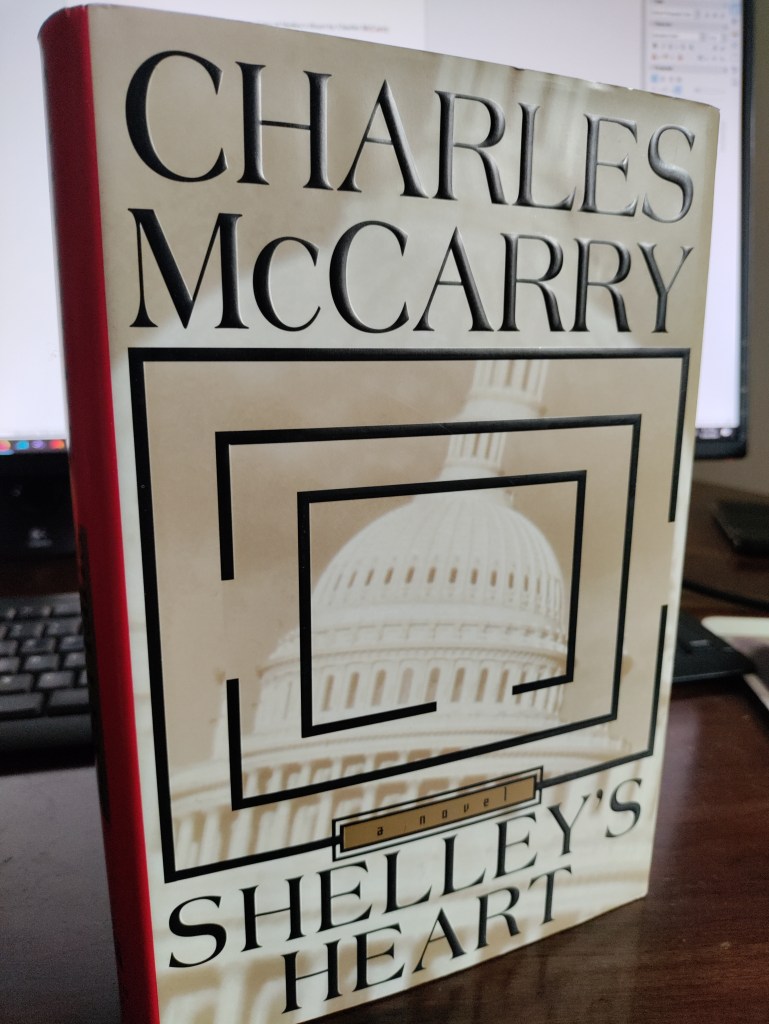
Here’s a picture of my copy of Shelley’s Heart by Charles McCarry.

It’s a first edition hardcover, but the second copy of the book I’ve owned. A few years ago I picked up and started reading a trade paperback edition, but I felt like the book was making me insane so I shelved it and, eventually, in one of my cataclysmic library-thinings, got rid of it. But recently, the book resurfaced in my brain and, on a whim, I grabbed this copy from a local used book store with a pretty deep Suspense/Thriller section (their Classic Literature section is shriveled but you can find some gems; ditto their ‘contemporary fiction’ zone; like many southern bookstores it has an enormous Religion section, but no interesting religious books; but it’s a good little store overall and you can find some tasty deep cuts with a bit of patience).

I first heard about McCarry in 2021, a year spent reading, almost exclusively, books in the mystery/thriller/suspense genre. Can’t spend much time in that field without encountering Otto Penzler, huge advocate for the genre. Penzler, somewhere or other, sang McCarry’s praises, so I looked him up, and found that he had other fans, including Jonathan Yardley, who I guess is an actual book critic but who I knew primarily as Frederick Exley’s biographer and a Book-Blurber, a Guy Whose Tastes Align with Mine Reasonably Often; I’m not going to look up the exact quote of Yardley’s because I am deeply afraid of spoiling the plot of Shelley’s Heart for myself, (and if I spoil the plot I won’t be able to go on reading it; the sheer vertiginous unpredictability, the never-knowing what the next chapter or, indeed, paragraph in Shelley’s Heart will bring, is what gives this Really Fucking Weird book its compulsive readability despite its pretty apparent, pretty persistent flaws), but it is something to the effect that Shelley’s Heart is the best novel ever written about Washington D.C.

So taking all that into account, it is not surprising to hear that Shelley’s Heart is a political thriller. Published in 1995, it is about a fictional presidential election, the first of the 21st century, so there’s an Infinite Jest-esque near futureness to it (about which more in future installments). It’s a bitterly contested race between Frosty Lockwood, left-of-center liberal of Lincoln-esque physique, and Franklin Mallory, steely-eyed conservative super-business-genius. Lockwood wins, but the plot is set in motion when Mallory confronts him with seemingly solid proof that the election was stolen through hi-tech voter fraud.

McCarry, before reincarnating himself as a writer, worked for both the CIA and the government at different times. As a young nerd he was a speechwriter for Dwight D. Eisenhower before hopping on for Nixon’s 1960 presidential campaign; later in life he wrote a biography of Ralph Nader called Citizen Nader.In an article for the Washington Post called“Between the Real and the Believable,” an interesting piece written in 1994, just as McCarry was wrapping up Shelley’s Heart, he says this about his transition from the political life to the writerly one:

For a decade at the height of the Cold War, I worked abroad under cover as an intelligence agent. After I resigned, intending to spend the rest of my life writing fiction and knowing what tricks the mind can play when the gates are thrown wide open, as they are by the act of writing, between the imagination and that part of the brain in which information is stored, I took the precaution of writing a closely remembered narrative of my clandestine experiences. After correcting the manuscript, I burned it.

What I kept for my own use was the atmosphere of secret life: How it worked on the five senses and what it did to the heart and mind. All the rest went up in flames, setting me free henceforth to make it all up. In all important matters, such as the creation of characters and the invention of plots, with rare and minor exceptions, that is what I have done. And, as might be expected, when I have been weak enough to use something that really happened as an episode in a novel, it is that piece of scrap, buried in a landfill of the imaginary, readers invariably refuse to believe.

It’s an article worth reading, if you’re reading Shelley’s Heart, or interested in doing so,because it’s a McCarrian microcosm, a little Peqoud in which, in miniature, you can see all his writerly qualities, good and bad, sailing side by side in a compact coastal foray, before embarking with them all again on the much longer transoceanic journey that is Shelley’s Heart; you’ve got his concise, clean prose, the moments of seeming-honesty both straightforward & elegant, his light-touch wit, his sneering nasal old boy’s snark, semi-masked under a But Please Consider This debate club ‘reasonableness’ that can be quaint fun sometimes, but that’s more often patronizing and annoying, particularly when directed at women and people with different temperaments than his own; I think his good qualities are easily visible in the above quote; for his bad, read this, describing one reader’s reaction to a character in a book of his (not Shelley’s Heart):

Soon after this work appeared, I found myself at a dinner party in Northampton, Mass., seated next to an agitated feminist, who, like my unhappy character, was young and beautiful and a recent bride. Throughout dinner, she told me how much she hated the girl in the book, whose behavior she had found to be utterly unrealistic and an insult to women — “male chauvinist propaganda,” she called it.

I was not surprised by the onslaught. For a writer in America, going out to dinner is like living as an American in Europe: Total strangers think they can say anything they like to you. Still, I had trouble grasping the point. Why did a 1950s fictional character have to conform to an ideological model that had not yet been invented at the period in which the novel took place?

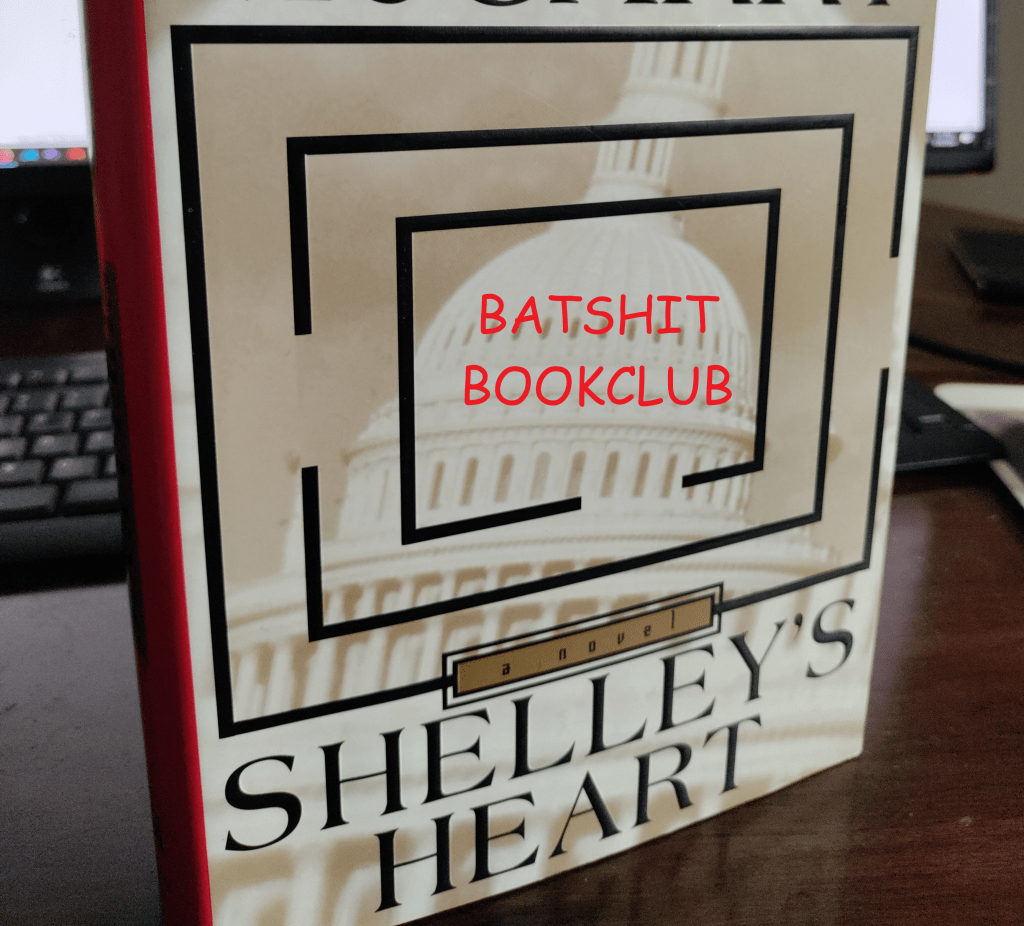
On the front of my copy of Shelley’s Heart is a photo of the Capitol building; inset within it, in a black square with a single entrance, is the same photo of the Capitol, albeit smaller, and with its own, smaller single-entrance black box; within that is the same again, smaller again; and again once more. The weird sepia tone of the Capitol photo evokes the grain of CCTV footage; the boxes make you think of mazes, or of hierarchies, or give the sensation of pressing deeper and deeper into some inner sanctum, passing tests until you reach the Center…

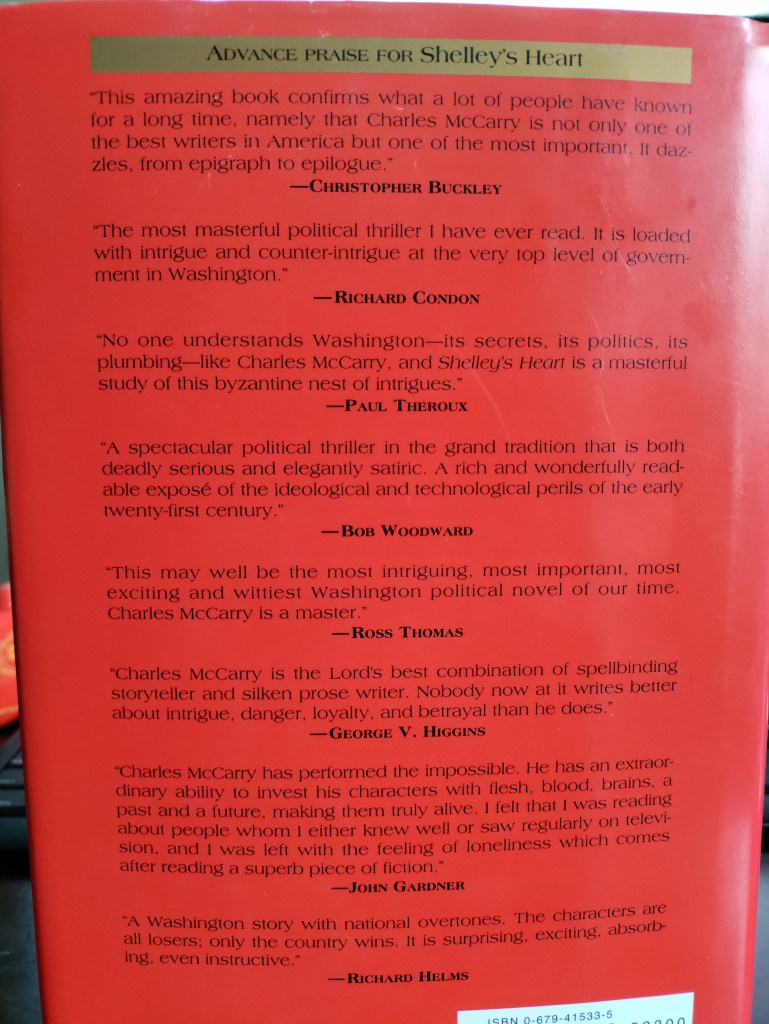
Here’s the back cover, given over wholly to Advance Praise:

Let’s break down this rogue’s gallery. You’ve got:

  • Christopher Buckley, son of William F. Buckley, Jr. Christopher’s the guy who wrote Thank You For Smoking, among other things. He was also the chief speechwriter for George H.W. Bush during his Vice Presidency. Looks like a dweeb, went to Yale.
  • Richard Condon, author of The Manchurian Candidate. Don’t know much about the book, but I know what the term ‘Manchurian Candidate’ means. Wikipedia also tells me that McCarry is an admirer of that book.
  • Paul Theroux, popular novelist and travel writer, the ‘Lawful Good’ Theroux brother. He seems like the odd man out personality-wise amongst the blurbers, but it’s a name many in 1995 would recognize, I guess. Maybe he’s written thematically-adjacent stuff, he’s one of those prolifics who has a whole second wikipedia page for their bibliography to unfurl across.
  • Bob Woodward, name I know, a face I don’t. Reporter on the Watergate Scandal for the Post, and wrote like four books about the George W. Bush presidency; he had a big hand in the Post’s coverage of 9/11, for which the outlet won a pulitzer in 2002 (lol).
  • Ross Thomas, a crime fiction author about whom I know very little. Wikipedia is not helpful here other than to point out he wrote the “McCorkle-Padillo series,” which sounds like it should be the name of some tedious sequence of integers that all share some obscure mathematical characterstic.
  • George V. Higgins, lawyer-turned-hugely influential crime/thriller writer, best known for the phenomenal Friends of Eddie Coyle. MA from Stanford, described as a “raconteur” by Wikipedia, which who knows what you have to do to get that to happen.
  • John Gardner – presumably the British crime novelist, not the American writer who debated with William H. Gass, wrote Grendel, etc. This Gardner wrote plenty of original stuff, but also’s one of those authors who wrote their own James Bond stories.
  • Richard Helms, political official and diplomat who was head of the CIA in the late 60s/early 70s. Definitely a nerd, probably a huge piece of shit. Looks like a less jowly Nixon.

There’s a precis on the front & back jacket flaps. When Against the Day came out and it was implied (but I don’t think ever confirmed) that Pynchon wrote the jacket copy, it never occurred to me that the authors themselves ever wrote their own jacket copy; ever since though I wonder. It’s possible, McCarry wrote this copy. It’s obviously glowing and sales pitch-y, and McCarry comes across (sometimes, anyway) like the kind of guy who would talk up his own stuff; although the specific hyperventilatory tone here doesn’t jibe with his generally cool, lightly mannered – “silken,” to use Higgins’s adjective – style elsewhere. It says of the election fraud scandal at the heart of Shelley’s Heart:

From this crisis, master storyteller Charles McCarry…has woven a powerful new novel that has been acclaimed even before publication as a masterpiece…”

We already looked at the back cover blubs but McCarry himself also offers a related tidbit in the aforementioned Post piece:

Not long ago, an old Washington hand, whom I had asked to read the galley proofs of my forthcoming novel about Washington and the management of a wholly fictitious constitutional crisis, phoned me in a dudgeon: “You’ve written about the way this town really is, and after looking into this mirror I’m not sure I want to go down to the office anymore.”

Back on the jacket flaps, the summary continues:

Shelley’s Heart is so gripping in its realism and so striking, even frightening, in its plausibility that McCarry’s devoted readers may have difficulty remembering that this tale of love, murder, betrayal, and life-or-death struggles for the political soul of America is a work of the imagination rather than an act of prophecy.

You could read those words “love, murder, betrayal” as another argument in favor of McCarry himself being the penman. They echo a list of his in a piece he wrote called “A Strip of Exposed Film,” published in a book called Paths of Resistance: The Art and Craft of the Political Novel, which gathers, from what I can gather, essays about political novels by various writers, those writers being McCarry, Marge Piercy, Isabel Allende, Robert Stone (writer of David Berman’s favorite novel, Dog Soldiers), and…..Gore fuckin’ Vidal! (This is a book I’d like to own). McCarry says:

The best novels, I believe, are about ordinary things: love, betrayal, death, trust, loneliness, marriage, fatherhood.

Perhaps at least whichever marketing intern or whoever absorbed this or other similar sentiments from McCarry before drumming up the copy, which also promises:

an ascetic, ideology-driven Chief Justice

an intriguing gallery of forceful women

an upper-crust secret society

and, last but most enticingly, that:

Above all, out of this crowd of extraordinary men and women emerges one person of striking originality, power, and all-too-human proclivity who will long remain in the reader’s memory.

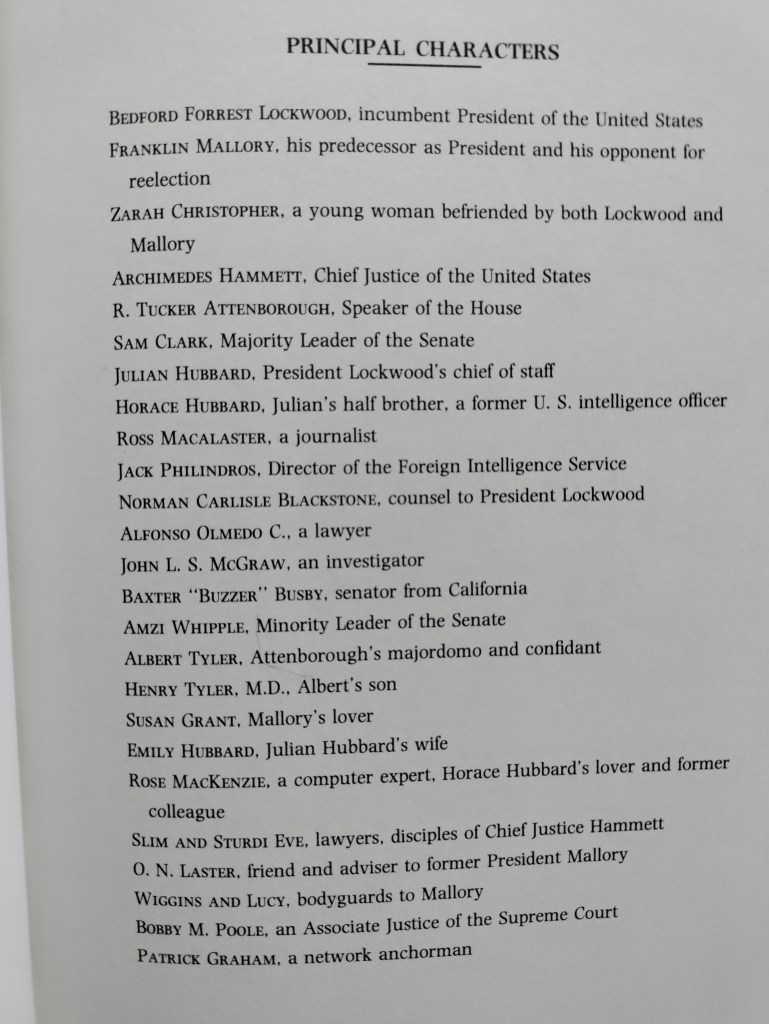
Relatedly, one last prolegomenon worth noting about the book is that it includes, before the text proper, a Dramatis Personae, and quite a dramatis personae it is; get a load of these names:

As I write this overture, I’m actually about a third of the way through the novel, and I’m not sure who the “person of striking originality, power, and all-too-human proclivity” is yet.

Next time: starting the book proper, and discussing Parts 1 and 2.